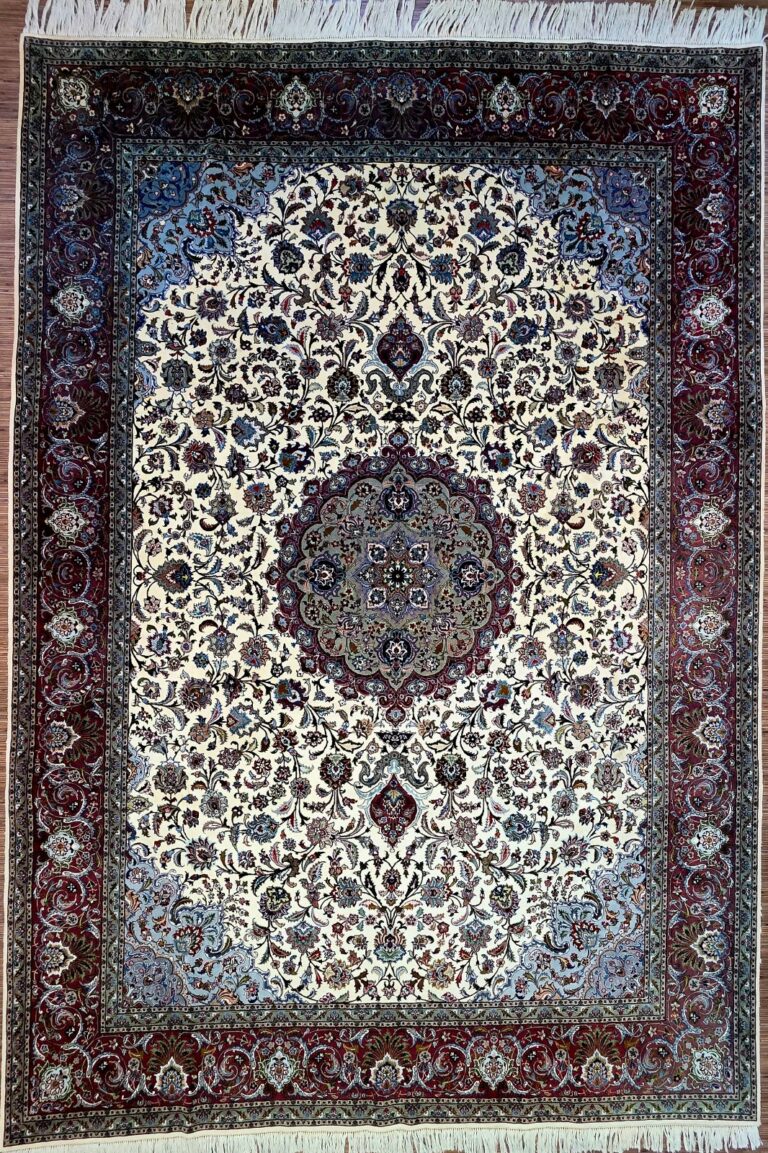
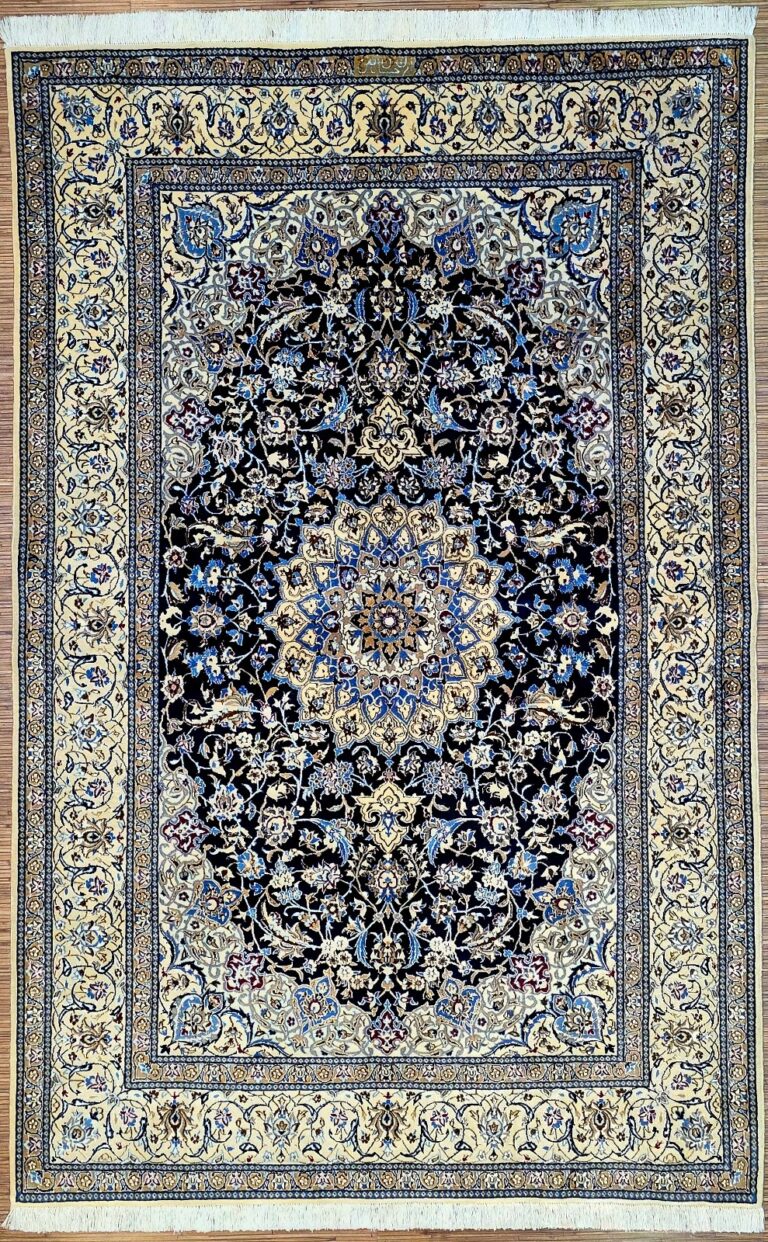
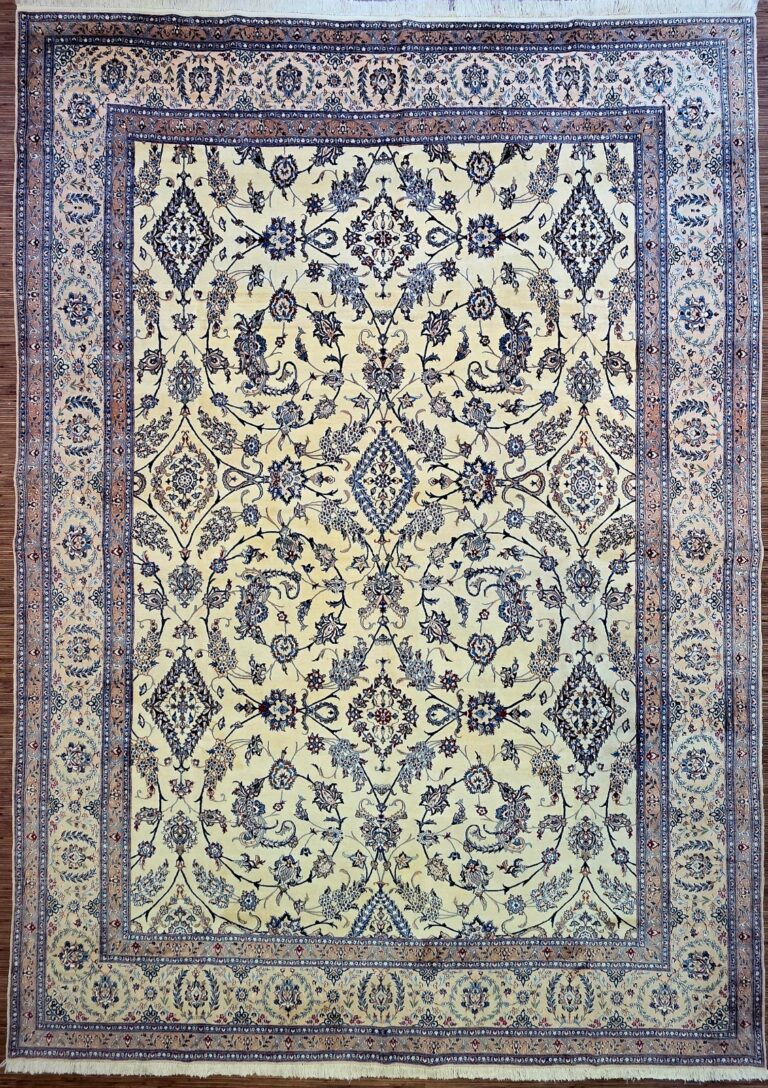
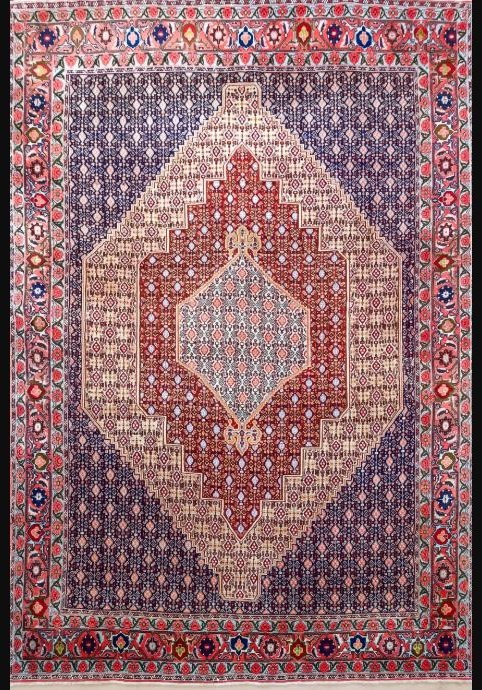
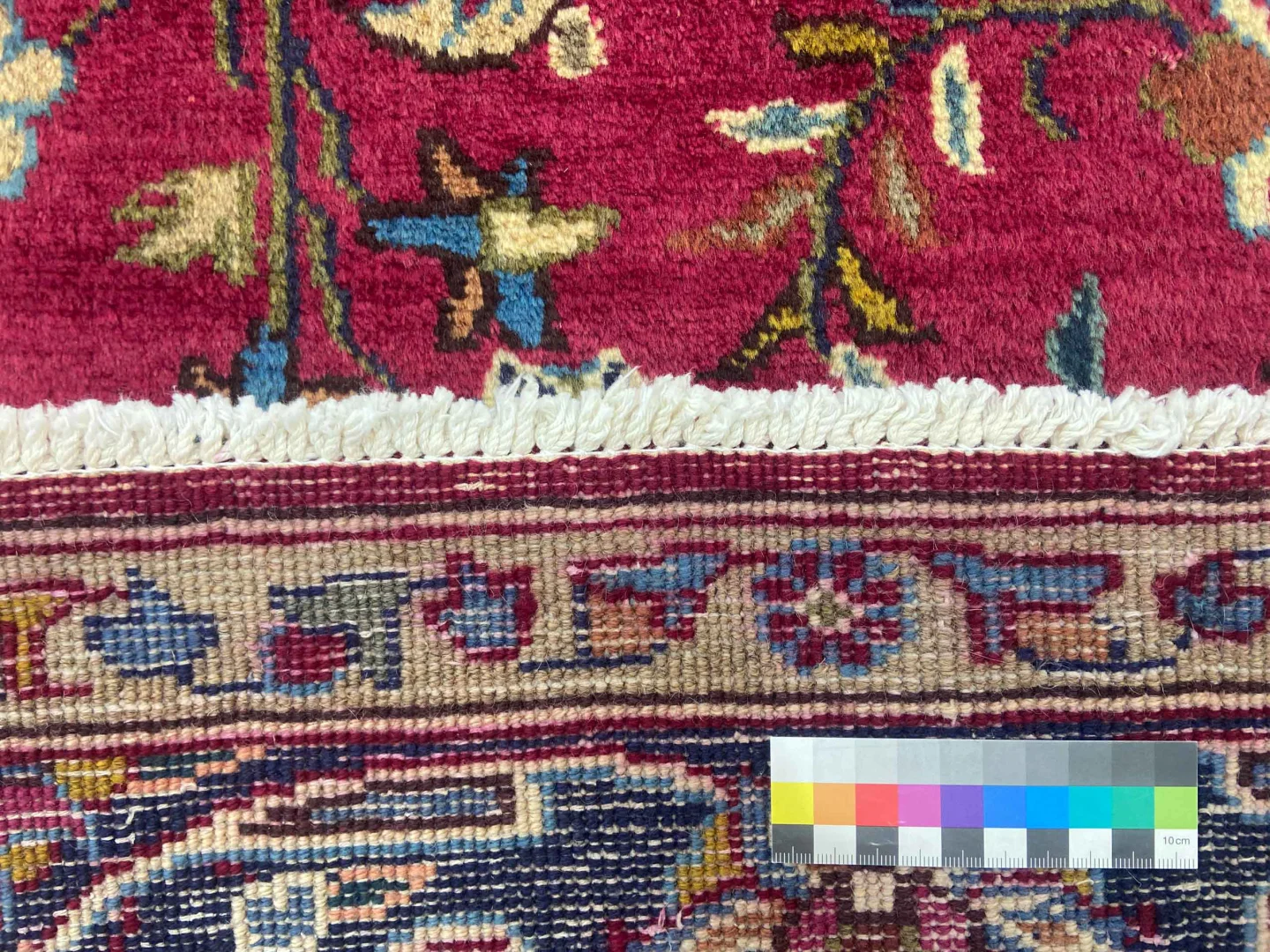
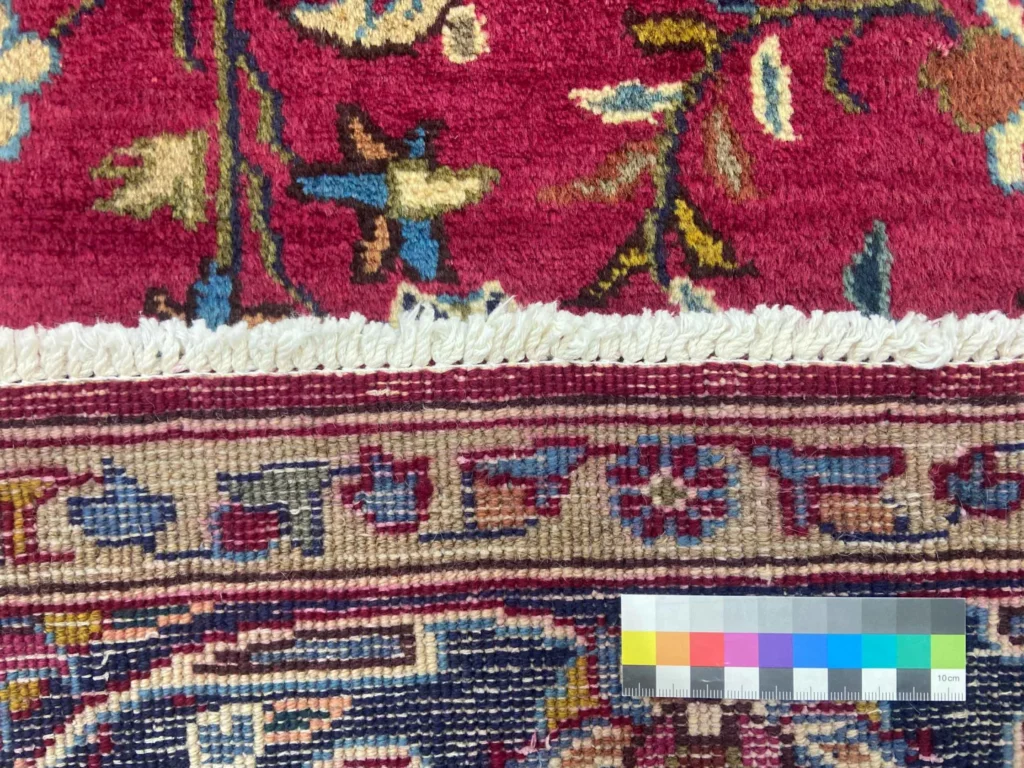
This Mashhad Persian rug is hand-knotted. In hand knotting, individual knots are tied into the foundation by hand, row after row, until the pile and the design take shape. Each part of the pattern is created through a sequence of separate manual steps. This differs from a machine-made floor covering, where the structure and decoration are produced industrially according to a fixed manufacturing process. Hand knotting is a defining method of Persian rug making and remains central to the craft tradition associated with Mashhad.
Mashhad Persian rugs are made mainly from wool. Wool is used in rug making because it combines softness with durability and can be prepared for different qualities of pile. Some Mashhad rugs may also contain silk accents. Silk can be used to highlight selected ornaments and introduce additional sheen to parts of the design. The exact fibre composition of this individual rug is not specified, so no further material or percentage is assigned to it.
Mashhad rugs can have a knot density ranging from 180,000 to 250,000 knots per square metre. Knot density indicates how many knots are tied within a defined area. In general, a greater number of knots permits finer outlines and more closely rendered small details. It is a technical reference for the fineness of the knotting, but it is not the only aspect used to assess a handmade rug. The foundation, the regularity of the rows, and the care with which the design is transferred are also relevant to the craftsmanship.
Hand knotting brings material, construction, and design together. Colours and motifs are not applied to a completed surface; they are formed as the knots are tied. The design therefore becomes part of the rug’s structure. In a floral composition, careful control of vines, blossoms, and contours is particularly important. The technical execution provides the basis for the legibility of the classic medallion and the plant-inspired ornaments that accompany it.
Origin and Tradition
Mashhad is one of the major historic cities in eastern Iran. It has an established regional place in Persian rug history and is associated with its own weaving tradition. The name Mashhad refers to more than a visual arrangement: it identifies a Persian place of origin and the body of craft knowledge connected with that region. This rug originates in Persia. Its designation therefore places it within an Iranian tradition of hand-knotted rug making.
Persian rug art combines inherited design forms with practical knowledge of materials and construction. Patterns are passed on over generations, while individual workshops and weavers interpret them in their own way. During hand knotting, the drawing, colour distribution, and outlines are transferred into the structure step by step. This requires close attention to the planned composition and to the sequence of colours and motifs. Persian rugs consequently unite a traditional visual language with the specific work of the people who make them.
Mashhad is commonly associated with rich colours and detailed ornament. Rugs from the region are produced in different sizes and qualities. Their design vocabulary includes floral compositions as well as layouts built around a central medallion. A Mashhad rug can therefore show different proportions, borders, and levels of detail while remaining part of the same regional tradition. The place name identifies the weaving origin; it is not simply a label for one isolated pattern.
The history of Persian rugs is also a history of pattern transmission. A design may be preserved as a model, but it is not necessarily reproduced identically in every workshop. The proportions of a medallion, the shape of flowers, the movement of vines, and the balance of colour fields may vary. Such variation is part of handmade production. Rugs from the same region can share a recognizable structure while retaining individual differences in drawing and execution.
Mashhad is often considered alongside other established Persian rug centres. Nain rugs are known for fine wool and particular dyes that can produce strong colour clarity. Kashan rugs are frequently associated with opulent, highly detailed designs that combine floral motifs with complex geometric elements. These names represent separate regional traditions. Similar decorative features do not change the Mashhad origin of a rug or make a floral medallion evidence of another province.
Ziegler and Sarough are also recognised names in the rug world. Rugs connected with these traditions are valued for distinctive patterns and the use of quality materials. They may share certain characteristics with Mashhad rugs, but each has its own stylistic and technical development. This piece is identified as a Mashhad Persian rug. It is not identified as a Nain, Kashan, Ziegler, or Sarough rug.
The term Persian rug separates Iranian origin from design vocabulary. A medallion, a flower, or a particular colour combination may appear in more than one region and cannot by itself establish a different place of origin. The regional name and its associated weaving tradition are the relevant points of classification. Here, Mashhad indicates a Persian origin in eastern Iran and the craft history connected with that centre.
Design and Pattern
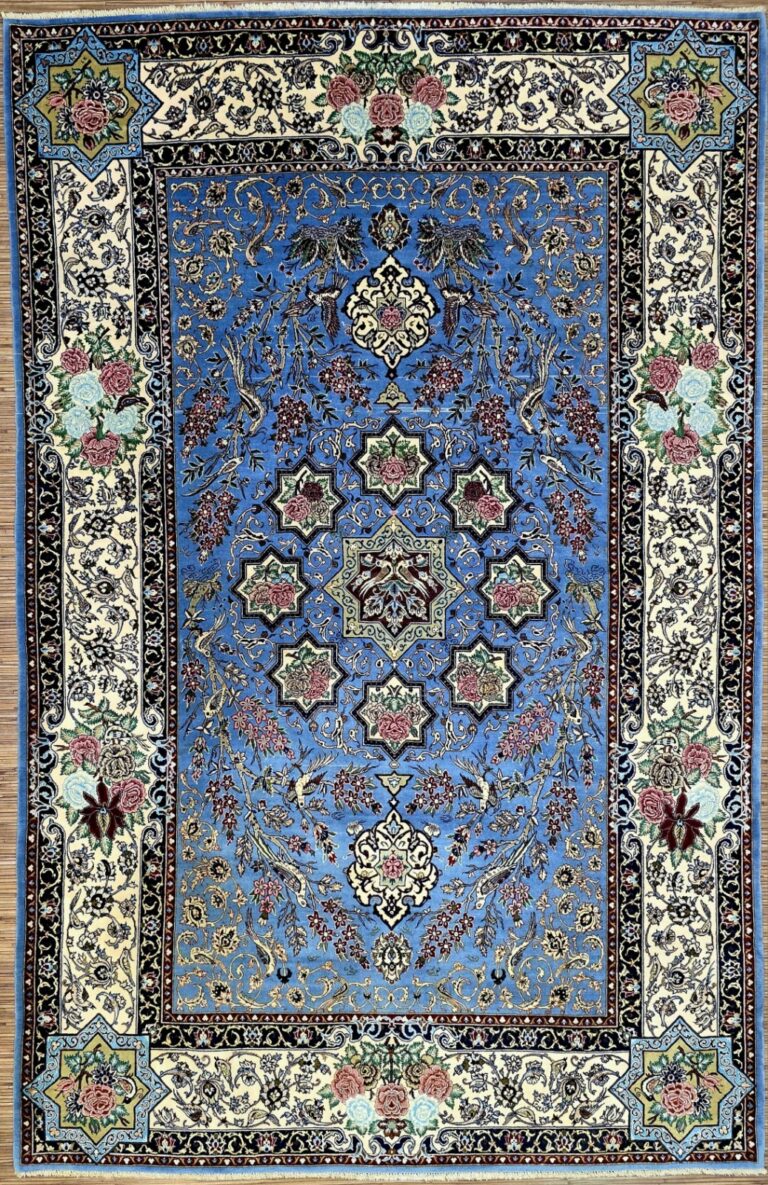
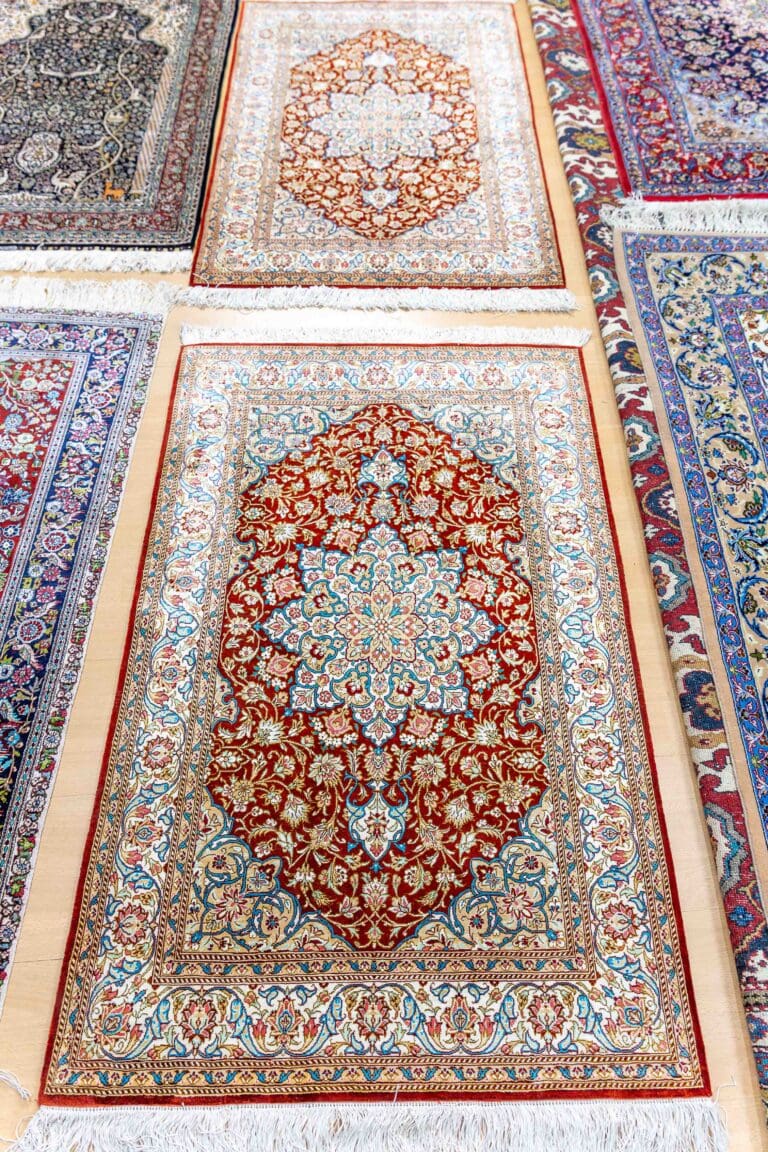
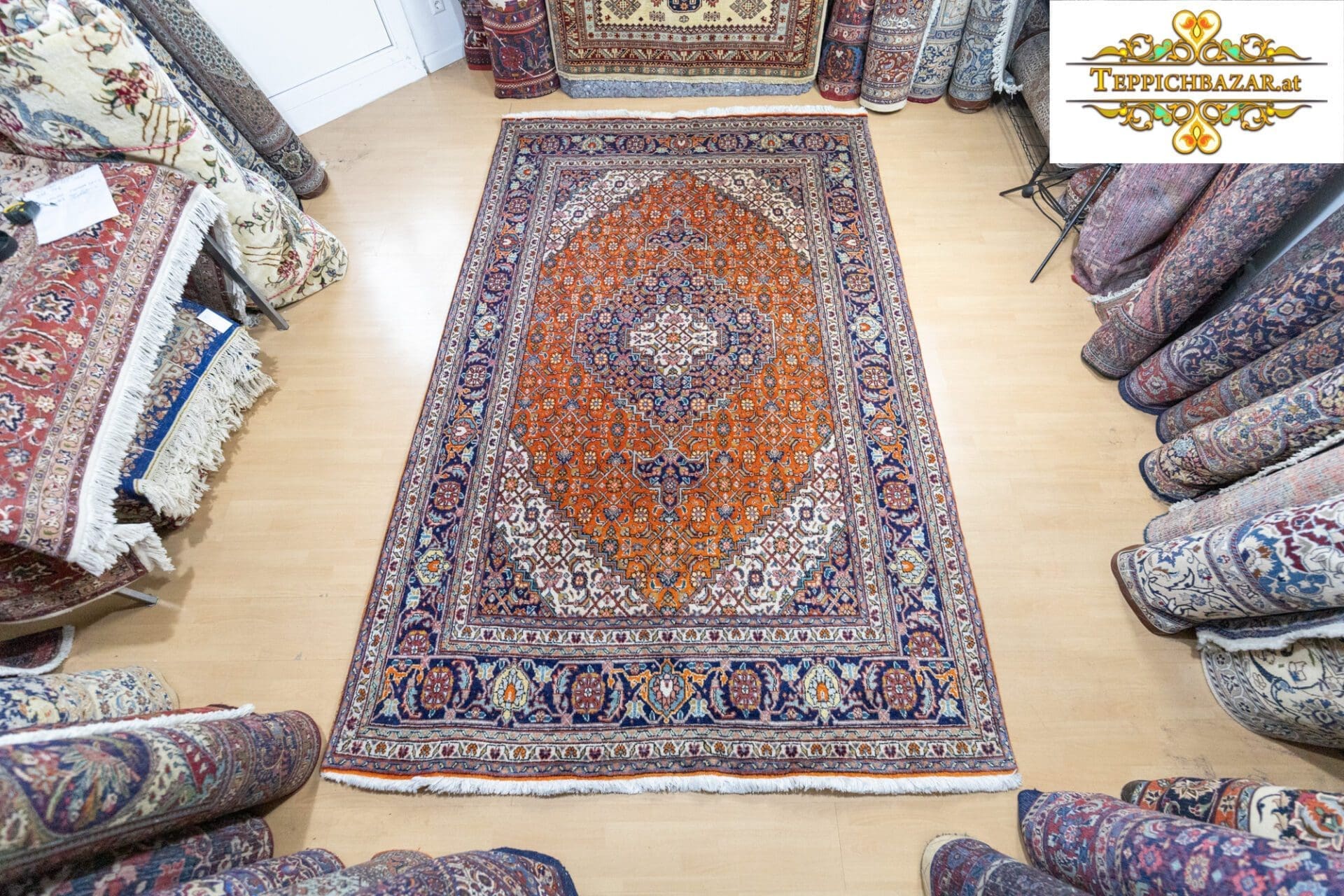
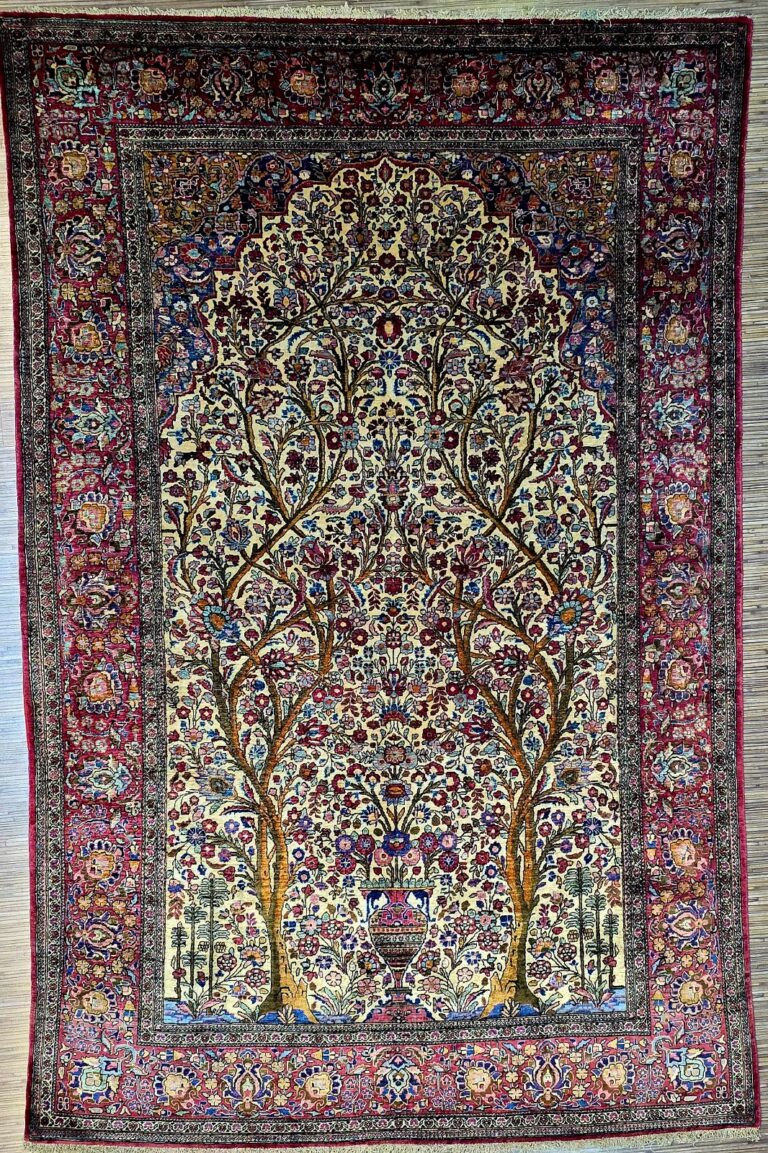
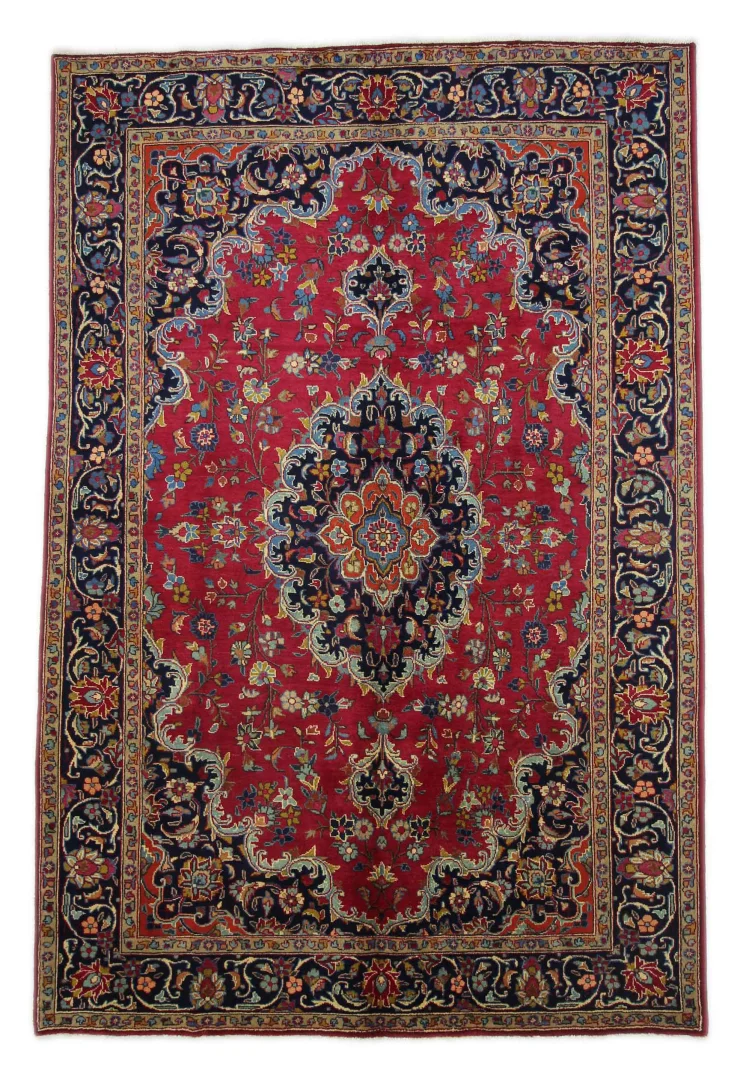
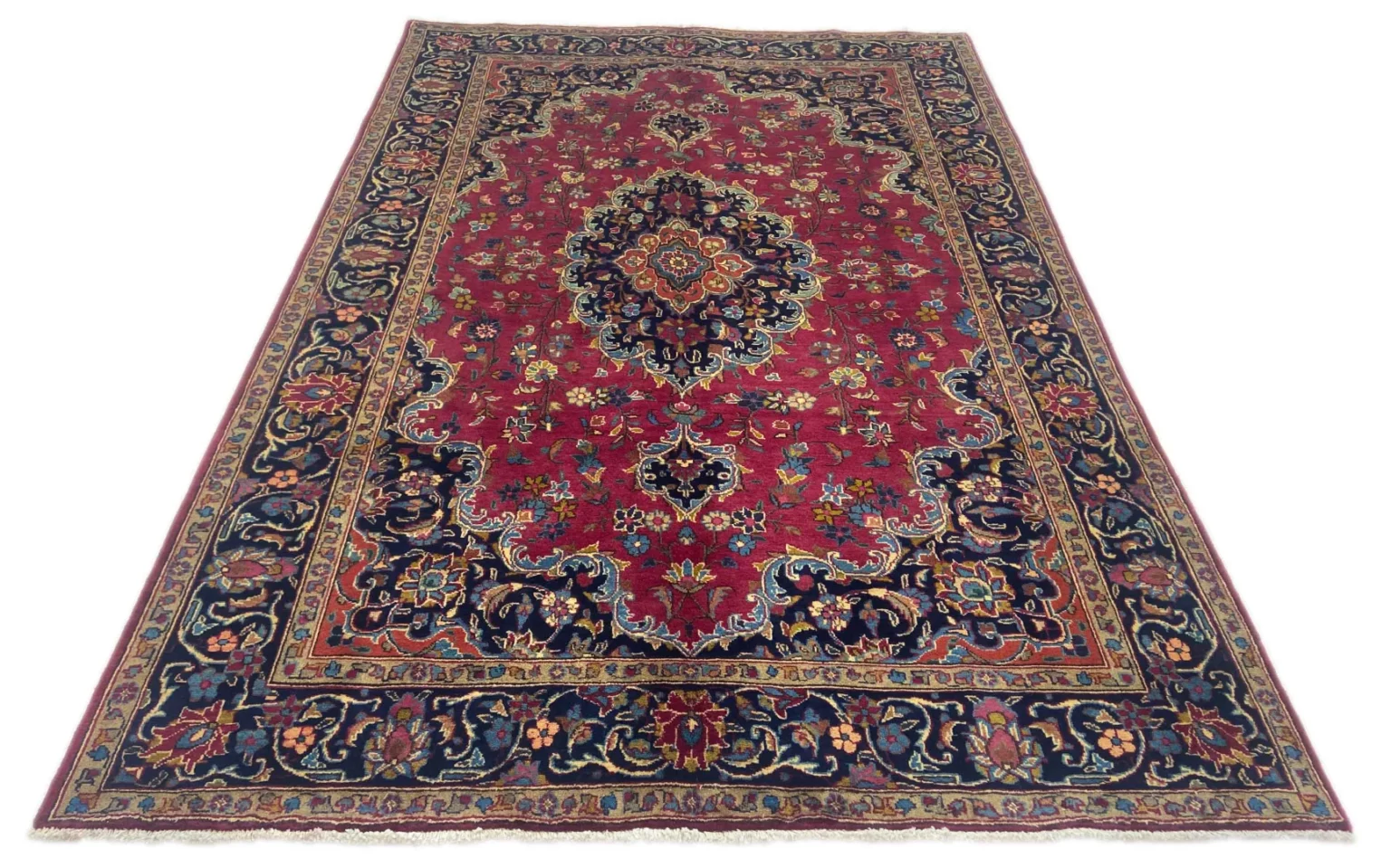
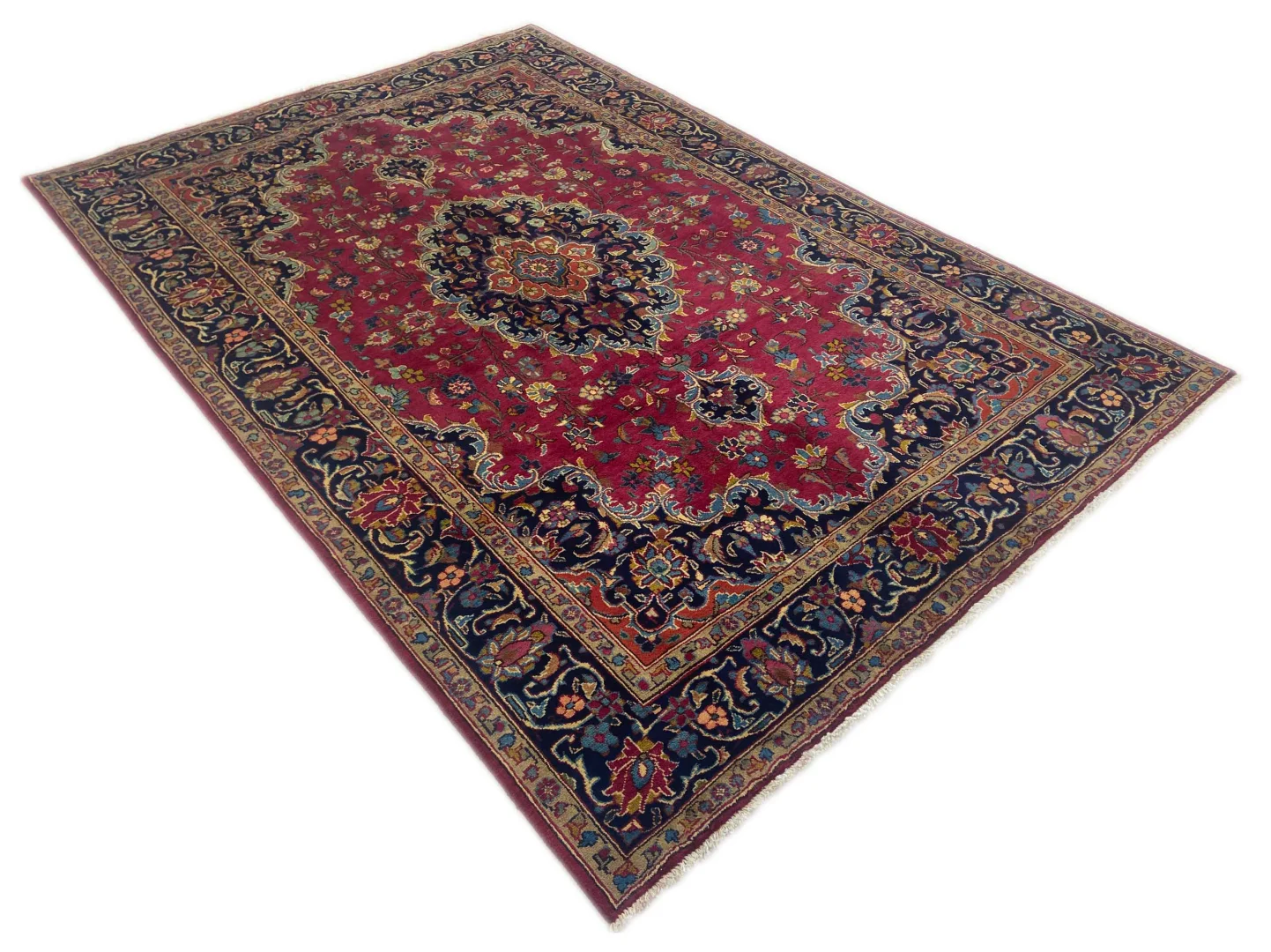
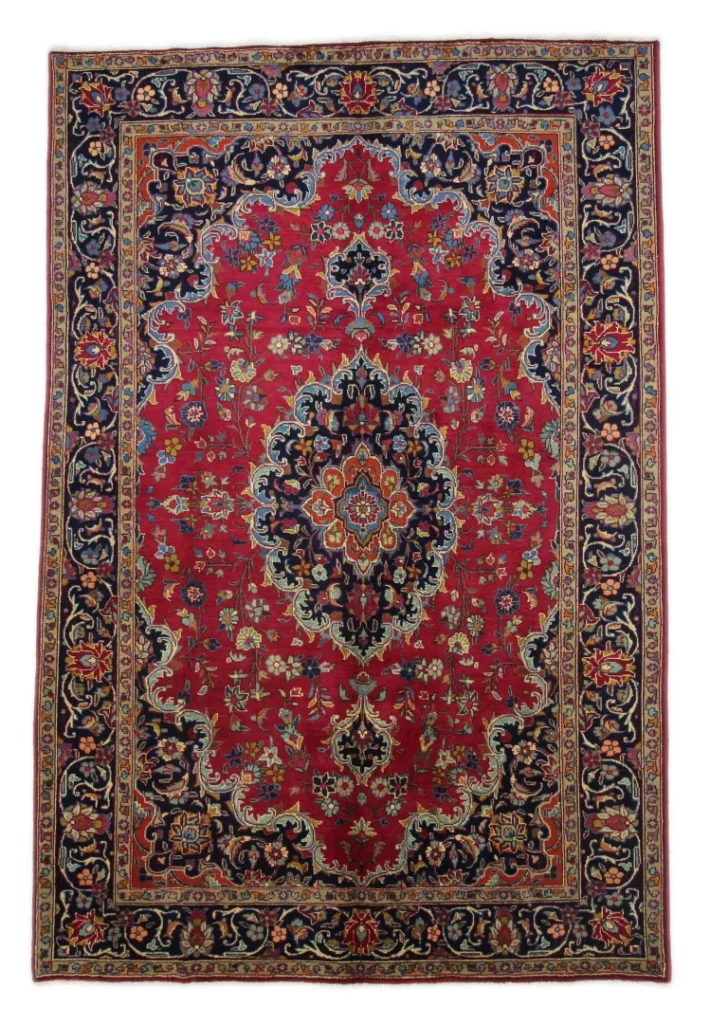
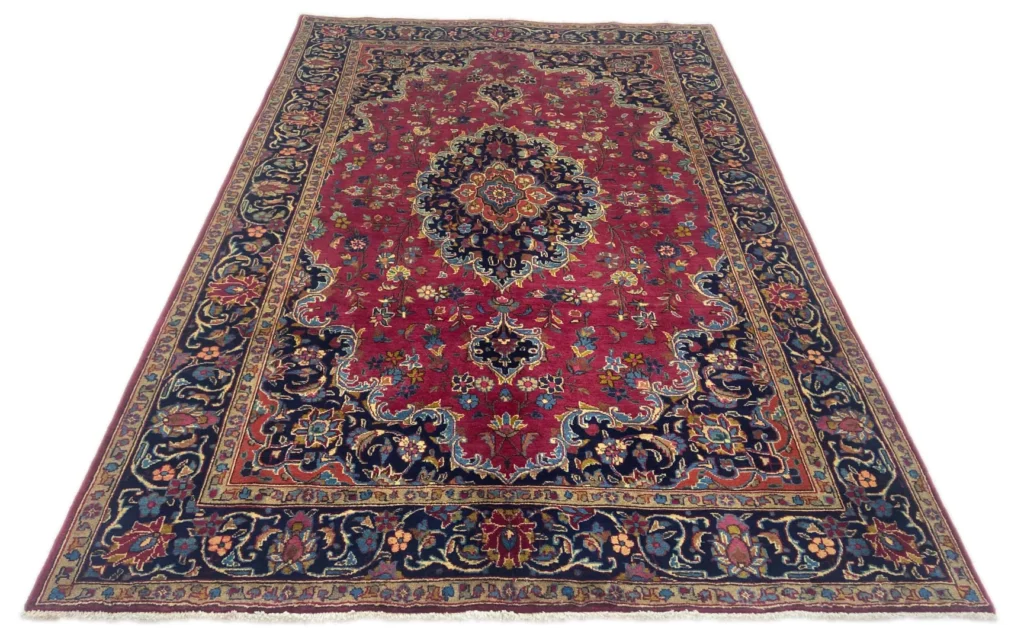
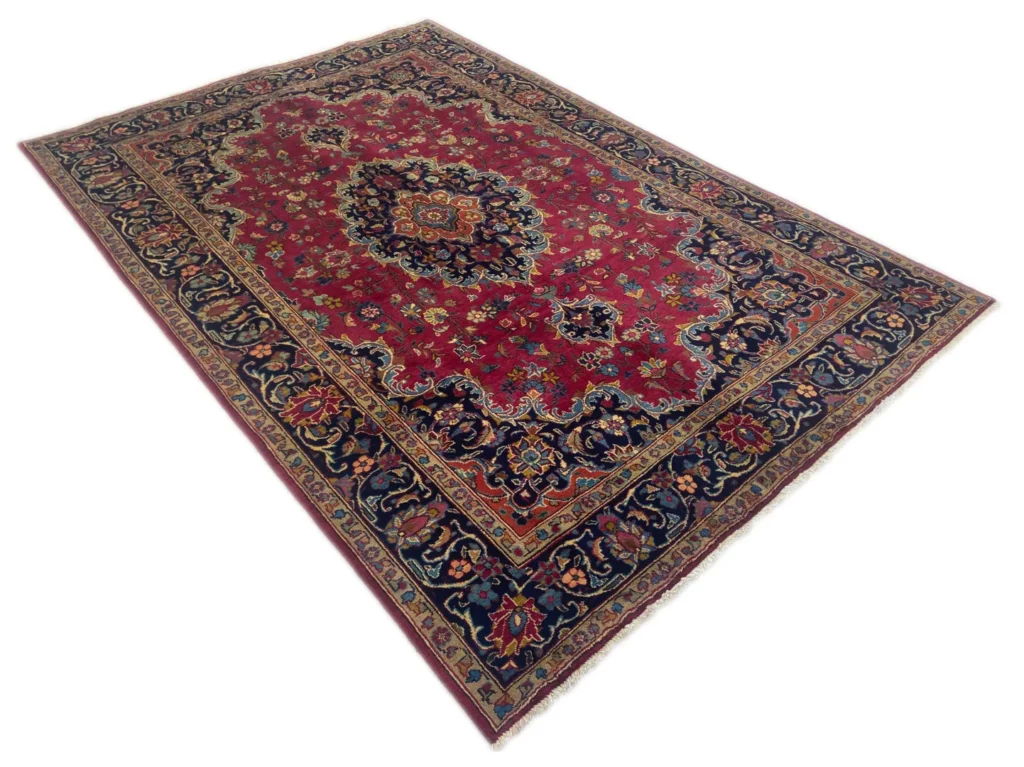
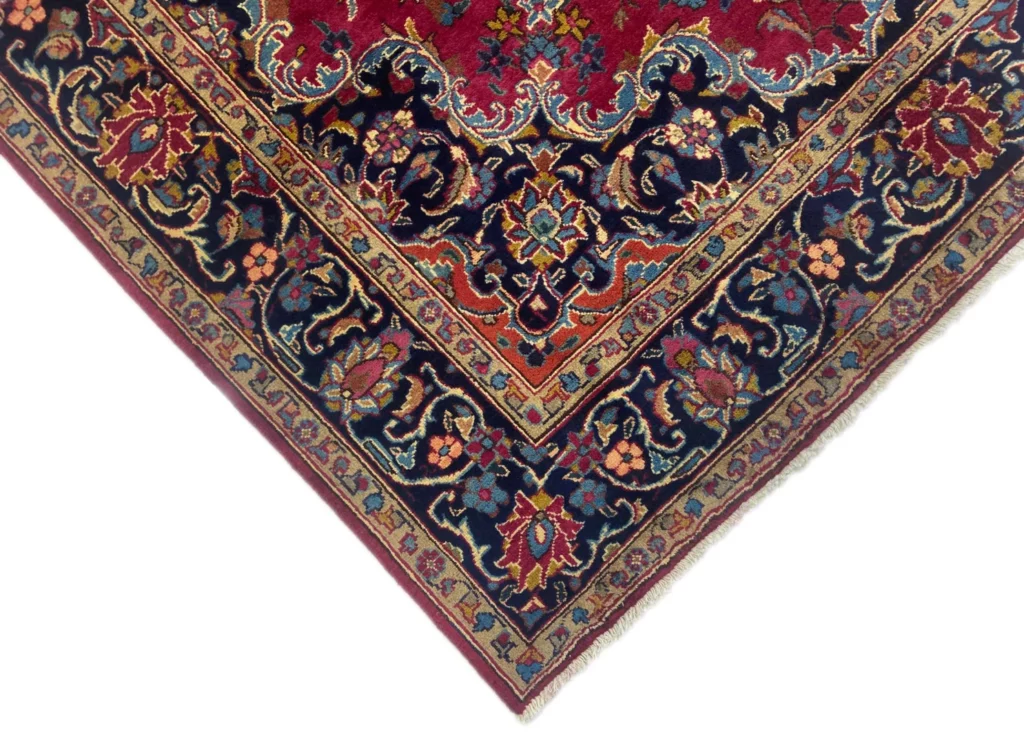
The design of this rug is described as floral with a classic medallion. In many Persian compositions, a medallion forms the visual centre of the field. It may be round, oval, polygonal, or divided into a more complex arrangement. The surrounding ornaments are organised in relation to this centre. A medallion gives the field a clear structure and creates a focal point within the complete composition.
Floral ornament is one of the principal forms of expression in Persian rug design. Blossoms, leaves, vines, and stylised plant shapes are transformed into an ordered decorative system. They are not necessarily intended as literal botanical representations. Natural forms are often simplified, repeated rhythmically, or arranged in balanced relationships. This stylisation creates a pattern that can be read across the field as a connected ornamental language.
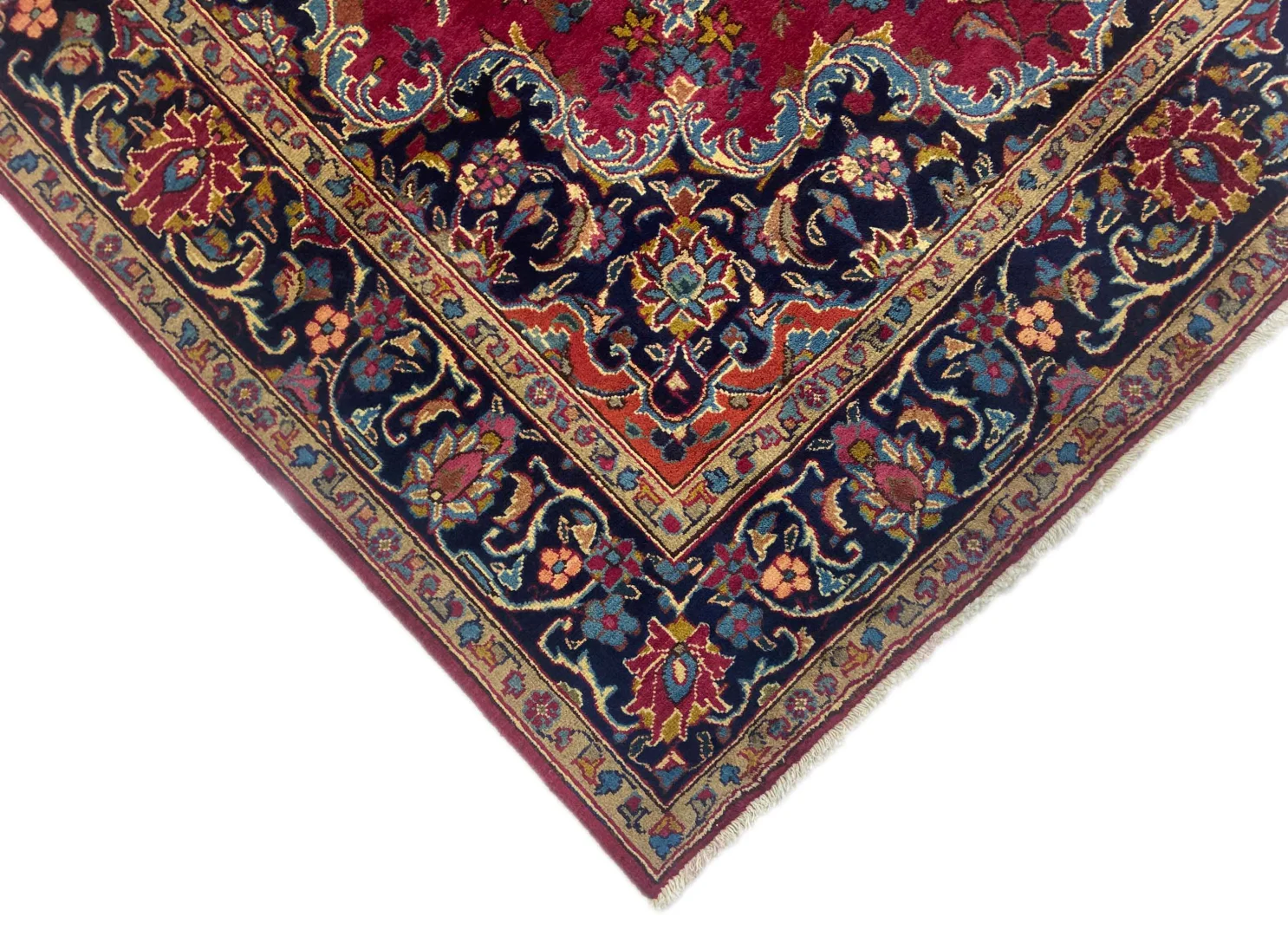
The colours listed for this rug are red, blue, and purple. Mashhad rugs often use red as a dominant ground or field colour, supported by additional shades. Blue can provide contrast, separate parts of the composition, or appear within flowers and vines. Purple adds another strong nuance to the palette. Together, these colours allow the floral details and central medallion to stand out while keeping the overall design connected.
A classic medallion is usually accompanied by additional ornaments. Vines may extend from the centre into the field, while leaves and blossoms shape the transitions around it. A border can frame the composition at the edges and repeat a related ornamental rhythm. In a floral design, the visual structure comes from the relationship between the central form, the surrounding motifs, the border, and the distribution of colour across the field.
Colour has a structural role as well as a decorative one. Light and dark areas can distinguish adjacent pattern sections. Contrasts clarify flowers and vines, while related shades create continuity between separate motifs. In Persian compositions, colour is often distributed so that the central medallion remains connected to the surrounding field rather than appearing isolated. Red, blue, and purple are the specifically named colours in this rug’s description.
The medallion is also a traditional organising device. It directs attention towards the centre and gives a broad field of ornament a hierarchy. Floral motifs can soften the geometry of this organisation without disrupting it. Plant forms are arranged so that they support the central structure and lead the eye through the surrounding space. In Mashhad rugs, this classical arrangement is often combined with a pronounced palette and detailed drawing.
Persian patterns have been transmitted over long periods and interpreted by different regional workshops. Two rugs may share a compositional principle and still differ in the treatment of their flowers, borders, proportions, and colour balance. That is a normal feature of handmade production. The pattern description of this one-off rug remains specific: it has a floral design with a classic medallion. No additional motifs or symbols are added.
Special Features
The rug is described as being in very good condition. Its other stated features are its hand-knotted construction, the colours red, blue, and purple, and the floral pattern with a classic medallion. The knot density is given as 180,000 to 250,000 knots per square metre. These details combine information about condition, technique, colour, pattern, and the technical density of the knotting.
The designation Mashhad Persian rug points to Persia and therefore to an Iranian origin. The floral medallion is a design element, not evidence of a different province. References to comparable Nain, Kashan, Ziegler, or Sarough rugs likewise do not change the origin of this rug or place it within one of those traditions.
No signature, production year, or specific age is stated for this piece. Its exact individual fibre composition is also not recorded. These details are therefore not added. The documented characteristics are the hand-knotted technique, knot density, colours, floral medallion design, Persian origin, and very good condition.
FAQ
How should a Mashhad Persian rug be cared for?
Regular vacuuming helps remove dust and loose dirt from the pile. Direct sunlight should be avoided because prolonged exposure may cause the colours to fade. If a stain appears, treat it carefully with a damp cloth and a mild cleaning agent. Vigorous rubbing, excessive moisture, and harsh chemicals can affect the surface or the appearance of the colours. For a thorough clean, professional rug cleaning is the appropriate complement to routine care, particularly when the condition of a hand-knotted rug is to be preserved.
What material is used for Mashhad Persian rugs?
Mashhad Persian rugs are made mainly from wool. Wool is known for softness and durability, which is why it is commonly used for the pile. Some rugs may also contain silk accents. These accents can add sheen to selected areas and strengthen the visual clarity of the colours. The general material tradition of Mashhad rugs should be distinguished from an exact fibre declaration for an individual piece when that composition has not been specifically stated.
How does a Mashhad Persian rug differ from other Persian rugs?
Mashhad Persian rugs are known for characteristic floral designs and a deep palette, especially shades of red, blue, and purple. They are also associated with high knot density and a distinctive, often opulent style. Nain rugs are known for fine wool and particular dyes, while Kashan rugs are frequently associated with elaborate floral and geometric designs. The differences therefore concern regional tradition, colour practice, pattern vocabulary, and the technical approach used by each weaving centre.
To provide the best experiences, we use technologies like cookies to store and/or access device information. Consenting to these technologies will allow us to process data such as browsing behavior or unique IDs on this site. Not consenting or withdrawing consent, may adversely affect certain features and functions.
Functional Immer aktiv
The technical storage or access is strictly necessary for the legitimate purpose of enabling the use of a specific service explicitly requested by the subscriber or user, or for the sole purpose of carrying out the transmission of a communication over an electronic communications network.
Preferences
The technical storage or access is necessary for the legitimate purpose of storing preferences that are not requested by the subscriber or user.
Statistics
The technical storage or access that is used exclusively for statistical purposes.The technical storage or access that is used exclusively for anonymous statistical purposes. Without a subpoena, voluntary compliance on the part of your Internet Service Provider, or additional records from a third party, information stored or retrieved for this purpose alone cannot usually be used to identify you.
Marketing
The technical storage or access is required to create user profiles to send advertising, or to track the user on a website or across several websites for similar marketing purposes.
Hallo! Suchen Sie einen bestimmten Teppich oder haben Sie Fragen zu Herkunft, Qualität, Größe oder Preis? Ich berate Sie gerne persönlich – kostenlos und unverbindlich.
Nicht gefunden, was Sie suchen? Über unser Netzwerk finden wir Ihren Wunschteppich – mit weltweitem Versand.
Abonnieren Sie unseren Newsletter und erhalten Sie unser Lexikon gratis als PDF: die Geschichte der Perserteppiche, historische Quellen, Knoten, Regionen und Motive. Oder folgen Sie uns auf Instagram, YouTube und TikTok.
 SICHERE ZAHLUNG
 VERSANDPARTNER